

The PC Is Being Reinvented: How NVIDIA’s RTX Spark Could Redefine Personal Computing for the Agentic AI Era
Computex 2026 may go down as the moment the AI PC stopped being a marketing term and became a genuine architectural shift.
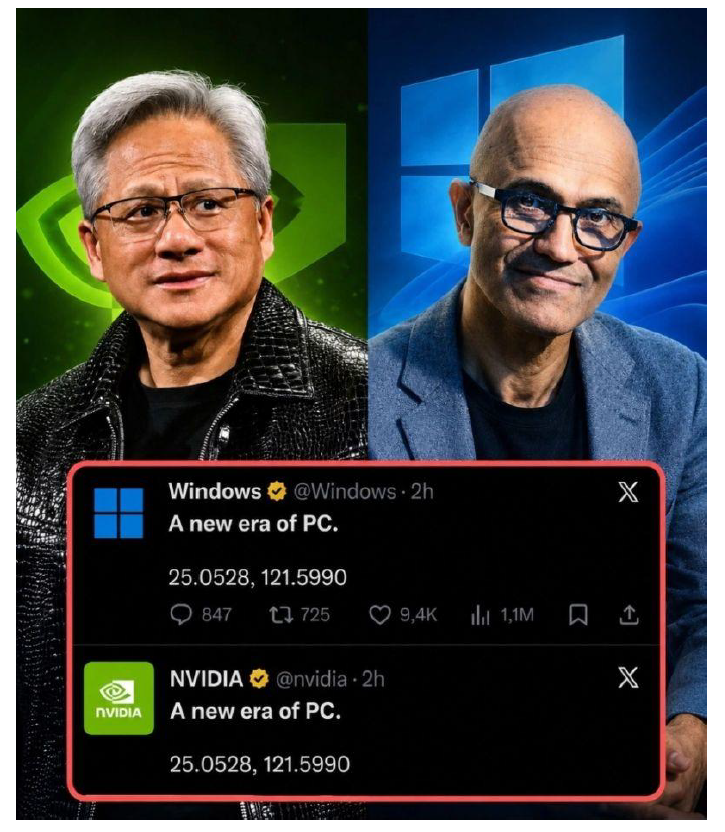
It started with four words and a set of GPS coordinates. In the days leading up to Computex 2026, NVIDIA and Microsoft posted identical messages on social media: “A new era of PC.” Alongside those words were two numbers — 25.0528, 121.5990 — the precise latitude and longitude of the Taipei Music Center, where Jensen Huang would take the stage on June 1. The tech industry’s rumor mill went into overdrive. Was this finally it? Was NVIDIA really entering the PC chip market? The answer, as it turned out, was a resounding yes.
What NVIDIA Just Announced — and Why It Matters
At his keynote during GTC Taipei 2026, Jensen Huang unveiled the NVIDIA RTX Spark Superchip — a Windows on Arm platform that the company boldly calls “the most efficient ever built.” This is not a GPU add-on or an AI accelerator bolted onto someone else’s processor. It is NVIDIA’s own complete system-on-chip, designed from the ground up for the era of personal AI agents. The RTX Spark Superchip integrates a 20-core NVIDIA Grace CPU alongside a Blackwell-generation GPU with 6,144 CUDA cores and fifth-generation Tensor Cores with FP4 precision — all connected via NVIDIA’s NVLink-C2C chip-to-chip interconnect. The top-end configuration pairs this with 128GB of unified memory, a figure that immediately draws comparisons to Apple’s M-series chips. MediaTek contributed its platform and CPU architecture expertise to make this integration possible, combining NVIDIA’s software ecosystem dominance with MediaTek’s proven experience in power-efficient mobile SoC design. Huang framed the announcement in sweeping historical terms: “For forty years, you launched apps. Click. Type. With RTX Spark and Microsoft Windows, you ask — and the PC does the work.” RTX Spark laptops and compact desktop PCs from leading manufacturers are expected to arrive this autumn.
The Long Road to This Moment
This announcement did not happen overnight. Rumors of NVIDIA entering the PC chip market have circulated for years under the codenames N1 and N1X. Geekbench entries, leaked Dell embargo pages, and Lenovo product listings all pointed toward an NVIDIA-powered laptop platform long before Jensen Huang stepped on stage. The path was not smooth — reports emerged of silicon redesigns, OS compatibility hurdles with Windows on Arm, and multiple delays that pushed the launch from 2025 into 2026. But the persistence paid off. NVIDIA committed to a full roadmap — not just one generation of Spark chips, but a multi-generational platform commitment. Beyond the current Grace Blackwell RTX Spark, Huang confirmed that every future platform generation will include a Spark chip: a Vera Rubin generation with LPDDR6 memory is already planned, followed by a future Rosa Feynman generation. This is not a one-off experiment. NVIDIA is in the PC business for the long term
The Battlefield: Four Forces Competing for Your Laptop
To understand why this matters, you need to understand the landscape NVIDIA is entering. For the past decade, the PC chip market has been a relatively stable duopoly. Intel and AMD have traded blows across consumer, gaming, and enterprise segments, building their ecosystems around the x86 architecture that has powered personal computing since the 1980s. Performance has improved year over year, but the fundamental paradigm has remained largely unchanged. Then came Apple. When Apple transitioned its Mac lineup to its own ARM-based M-series silicon starting in 2020, the industry was forced to reckon with what a tightly integrated hardware-software stack could achieve. The M-series chips demonstrated that ARM architecture was not a compromise for mobile devices — it was a legitimate path to laptop and desktop supremacy. Apple’s unified memory architecture, where the CPU and GPU share the same high-bandwidth memory pool, unlocked levels of performance-per-watt that x86 chips struggled to match. Qualcomm saw the opportunity and launched Snapdragon X Elite to bring the Windows on Arm dream to reality. While the effort has shown genuine promise, compatibility issues, software gaps, and the absence of a strong GPU story have limited Qualcomm’s traction in the premium PC segment. Now NVIDIA enters with credentials none of the others can fully claim: it owns the world’s most important GPU architecture, the most widely adopted AI software ecosystem (CUDA), and decades of experience in accelerated computing. The RTX Spark benchmarks already circulating show performance comparable to AMD’s Ryzen AI Max+ and significantly ahead of Qualcomm’s Snapdragon X Elite — though Apple’s M4 Max still leads in raw CPU throughput. This is a first generation. The roadmap suggests NVIDIA intends to close that gap fast.
The Real Story: Agentic AI Moves to the Edge
Impressive benchmark numbers are not the actual story here. The real shift is philosophical — and it has profound implications for how we think about AI itself. For the past several years, the most powerful AI capabilities have lived in the cloud. When you use a large language model, generate an image, or run a complex reasoning task, the actual compute has happened on racks of NVIDIA GPUs inside data centers owned by hyperscalers. Your laptop has been, in Jensen Huang’s framing, a window into AI — not an AI machine itself. The RTX Spark platform is designed to change that. NVIDIA explicitly positioned this as a platform for personal AI agents — systems capable of reasoning, taking autonomous actions, and working persistently on your behalf. Instead of relying on the same mouse and keyboard inputs that have defined personal computing for four decades, NVIDIA envisions AI agents as a new interface layer: one that allows users to command their systems, automate workflows, and find information through natural language.What does that look like in practice? Consider the difference between asking a cloud AI to help you write code versus having a local agent that understands your entire codebase, monitors your project state, runs tests autonomously, and iterates continuously — all without a single API call leaving your machine. Or a research agent that reads and synthesizes documents locally, maintains context across sessions, and generates reports without any of your sensitive data touching an external server. These are not futuristic concepts. They are use cases that become practical when you have RTX 5070-class GPU performance, 128GB of unified memory, and a capable NPU all sitting inside your laptop. Privacy is an underappreciated dimension of this shift. Running AI locally means your code, your documents, your ideas, and your workflows never leave your device. For enterprises, law firms, hospitals, and anyone handling sensitive data, local AI is not just a convenience — it is a compliance and security imperative.
Why the AI Software Ecosystem May Be NVIDIA’s Biggest Advantage
Hardware specifications tell part of the story. Software tells the rest. NVIDIA’s CUDA platform has been the backbone of AI development for nearly two decades. Every major AI framework — PyTorch, TensorFlow, JAX — is optimized for CUDA. Every AI model worth deploying has been trained on NVIDIA hardware. The software stack that powers the world’s AI data centers is NVIDIA’s stack. By bringing this ecosystem to consumer laptops, NVIDIA is doing something Qualcomm and even Apple have struggled to replicate: giving developers and researchers the ability to run the same software stack on their laptop that runs in the cloud. The RTX Spark announcement explicitly brings CUDA, RTX, DLSS, FP4, TensorRT, OptiX, Reflex, and G-SYNC into this compact platform. Over 1,000 RTX-enhanced applications are already available. Developers do not need to rewrite or adapt their workflows — the platform comes to them. This is a strategic masterstroke. Qualcomm has faced years of developer friction getting software to run natively on Snapdragon X. Apple’s ecosystem is exceptional, but it is Apple’s ecosystem — largely closed to the tools and workflows that power enterprise AI development. NVIDIA is betting that bringing the familiar, trusted CUDA ecosystem to ARM-based Windows laptops will lower the barrier to adoption dramatically.
The Industry’s Response
The market’s reaction was immediate and telling. Following Huang’s keynote, shares of Intel, AMD, and Qualcomm all fell. Wall Street read the announcement clearly: NVIDIA is not entering the PC market to compete at the margin. It is entering to redefine the category. AMD and Intel are not standing still — AMD’s Ryzen AI Max+ has been a strong performer in the premium segment, and Intel continues to push AI capabilities through its Core Ultra lineup. But neither has NVIDIA’s combination of GPU credibility, AI software ecosystem depth, and the momentum of being the defining company of the AI era. For Qualcomm specifically, the threat is existential in the Windows on Arm segment. If NVIDIA can deliver a superior ARM-based Windows experience with better GPU performance, broader software compatibility, and the CUDA halo effect, Qualcomm’s competitive differentiation arrows considerably.
What Comes Next
RTX Spark laptops and compact desktops are expected to hit shelves this autumn from major manufacturers including Dell (XPS), Lenovo, and others. The entry-level configuration details beyond the flagship Superchip remain to be fully disclosed, suggesting a range of price points designed to address different market segments. The multi-generational roadmap — Grace Blackwell now, Vera Rubin next, Rosa Feynman after that — signals that this is a sustained platform investment, not a proof of concept. Partners and developers can build on RTX Spark with confidence that the platform will evolve. The collaboration with Microsoft is equally significant. Windows is being repositioned as an agentic AI platform — an operating system where AI agents are first-class participants alongside traditional applications. This is a joint vision between two of the most powerful companies in technology, and it will shape the direction of personal computing for years to come.
A Forty-Year Shift, Compressed into One Keynote
Jensen Huang stood on stage in Taipei — the city near where he was born — and declared that the PC is being reinvented. Not upgraded. Not refreshed. Reinvented.For forty years, the personal computer has been a tool that executes instructions. You click, you type, you command. The machine responds.The intelligence, such as it was, has always lived in the software you installed or, more recently, in cloud services you connected to.The RTX Spark platform represents a genuine architectural bet that the next forty years will be different. That the intelligence will live in the machine itself. That your laptop will stop being a terminal into the cloud and start being a capable AI agent in its own right — coding for you,researching for you, automating for you, creating for you, all locally, all privately, all at frontier-model performance levels.Whether NVIDIA fully delivers on that vision in the first generation of RTX Spark systems remains to be seen. Benchmark numbers from earlytesting suggest genuine competitive performance, even if Apple’s M4 Max retains a CPU lead. The software ecosystem advantage is real. Theroadmap commitment is credible.But what is already clear is that Computex 2026 was not just another product launch. It was the moment NVIDIA declared that the AI revolution it built in the data center is coming home — to the desk wherethe future is built.The agentic AI era of the PC has officially begun.